
unus anima
fiction++
world building + artefact
PART I
The present global state of affairs mimics the popular fictional narrative of a society inching towards dystopia. Whether this is the final leg of our societies’ descent from reason to tyranny or a mere manifestation of the fear and worry that human civilization has always brewed--played like the illusory Shepard tone, always nearing the end, but never quite there--remains to be seen.
Unus anima is a world building exercise: a speculation into how our present habits and structures may warp our future. It takes a darker detour from a short story I wrote a few years back.
“..Centralized yet without central control, Pangea is one organism, that has eradicated race, poverty, gender, greed and ‘conflict of interests.’ What was once the human race, is now one consciousness living through millions of vessels and every vessel is now a cog with a purpose in the larger machine.”
PART II
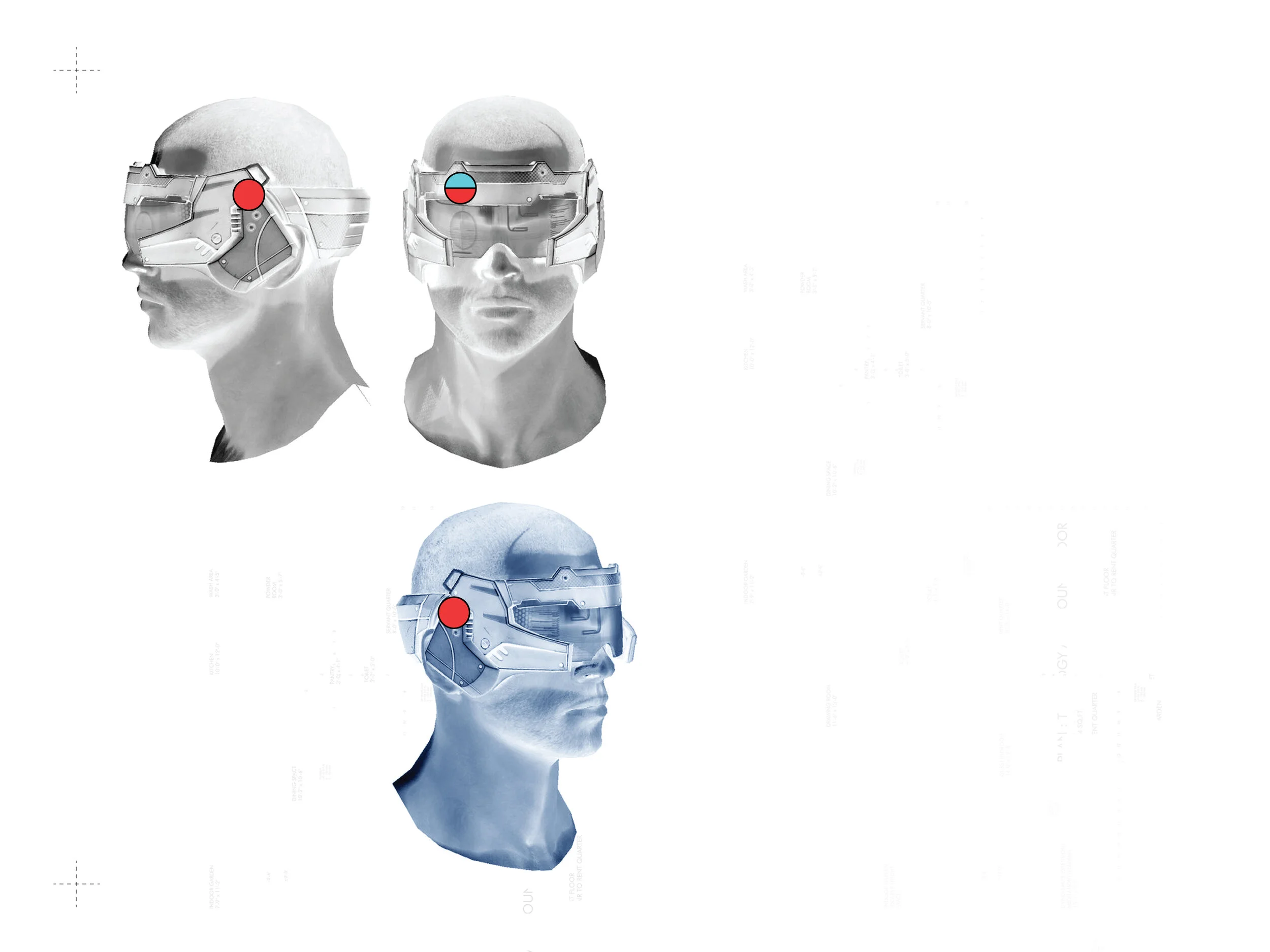
As a follow up of the world-building project I wanted to merge my learning in electronics and fabrication to work on something that has been of interest to me for a while. Like an ant or a termite colony that exhibits collective intelligence, or hints of a shared consciousness, I am trying to make a device that could emulate what it would be like to have a Manifestation of the Wisdom of the Crowd. A headgear/wearable that emulates what it would be like to have a shared consciousness or a singular consciousness, where information processing manifests as wisdom of the crowd.
A query is posed, a question asked, accompanied with constant visual feed; answered by everyone. Near-naked thoughts. All perception of the visual world is built by the crowd. What you see is constantly streamed across to the crowd and what you query is answered by everyone. Ubiquitous assimilation. The most common answer is filtered through to you.
Consider two users - Anne and Bob wearing and Exo Assist Device. Essentially devices/headsets like this would be able to talk to each other (users wearing them will communicate through them). The device will have partial sensory deprivation (noise cancellation and selective visual input). An integrated camera will provide a visual input to whomever Anne is communicating with, say Bob, and anyone else wearing the device. On an integrated screen, Anne and Bob will see whatever the other is seeing. Similarly audio input will be cross-linked, albeit in a robotic voice: Anne hears what Bob has to say or query about and Bob can hear Anne’s response. This will be possible between multiple users.
A scenario would be that one user looks at something and asks a question that is relayed (video and audio feed) to the entire “crowd” or network of connected users and the crowd can respond, which is then fed back (whispered back) to the initial user. In another iteration the speech is converted to text, so users in the crowd only get visual input.
All perception of the visual world is built by this crowd.
In another iteration the speech is converted to text, so users in the crowd only get visual input. So far I have been able to set up a visual feedback system where in a remote camera, powered locally, can send visual feedback (images at the rate of 30 per second - enough to give the illusion of fluid motion) to a server which has a display attached to it.
This remains a work in progress.
Ideal Device.